Opinion piece by Yasmina Madafi, Managing Director and co-founder of La Nouvelle Agence
The series Rematch brings back into the spotlight one of the most memorable showdowns of the late 20th century: the epic clash between Garry Kasparov, world chess champion, and Deep Blue, IBM’s chess-playing computer. In 1997, the match transcended the world of sport to become a symbol: for the first time, a machine capable of calculating millions of moves gained the upper hand over a human, challenging our assumptions about the superiority of human intelligence.
Kasparov vs. Deep Blue: David and Goliath
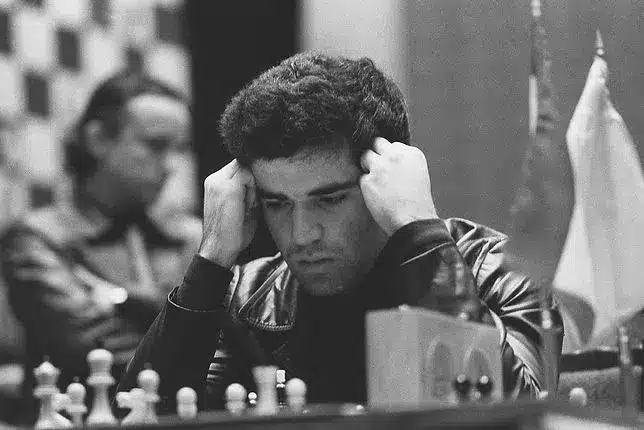
When Kasparov faced Deep Blue, he was virtually unbeatable, the greatest chess player of his generation, accustomed to defeating his opponents through ingenious strategies and razor-sharp instincts. But this time, he was not facing another human being. His opponent was a new kind of machine: a computer designed to analyse positions and calculate, in a matter of seconds, countless possibilities in a game renowned for its intellectual complexity.
Rematch portrays this confrontation with remarkable intensity. Far from being simply a series about chess, it turns every Kasparov move and every Deep Blue response into a moment of almost cinematic suspense. The legendary player, embodying the intuition and subtlety of the human mind, finds himself pitted against a relentless machine capable of calculating without fatigue or emotion. Every move, every decision Kasparov makes becomes a challenge against what feels like a digital Goliath.
A confrontation that still resonates today
Rematch takes us back more than twenty years, yet the question it raises remains as relevant as ever: can we, as humans, continue to control the technologies we create? In 1997, Deep Blue’s victory came as a shock, first and foremost to Kasparov himself, who had to confront the harsh reality of being defeated by a machine. But the match, emblematic of our complex relationship with technology, soon took on a much broader significance. Kasparov became a symbol of human resistance, embodying our reluctance to surrender to the machine.
Today, as artificial intelligence becomes increasingly embedded in our everyday lives – from voice assistants and recommendation algorithms to autonomous vehicles – the debate sparked by the Kasparov–Deep Blue match is far from over. Advances in AI, from ChatGPT to driverless cars, raise new questions for society: how far should we go? How should we regulate these technologies? And where should we draw the line? By placing this seminal confrontation at the heart of its story, Rematch seems to suggest that the debate over the relationship between humans and machines has only just begun.
A symbol of an enduring question
Through Kasparov, Rematch explores a question that continues to evolve. In 1997, the issue was whether a human could beat a machine at chess. Today, the stakes are far greater: can AI help us solve some of our most complex problems, or could it ultimately move beyond our control? Kasparov, portrayed in the series as the last bastion of human supremacy, becomes the embodiment of a concern that is still very much with us today: what happens when the machine appears to outpace its creator?
Rematch reminds us that beyond technological progress, humanity’s place in an increasingly automated world remains to be defined. More than a reconstruction of a historic chess match, the series captures a pivotal moment when we began to question what technological progress might mean for our own future. And it leaves us with one final question: as machines continue to advance, will we be ready for the next “rematch”?